ONE DAY IN THE CENTRAL PARK
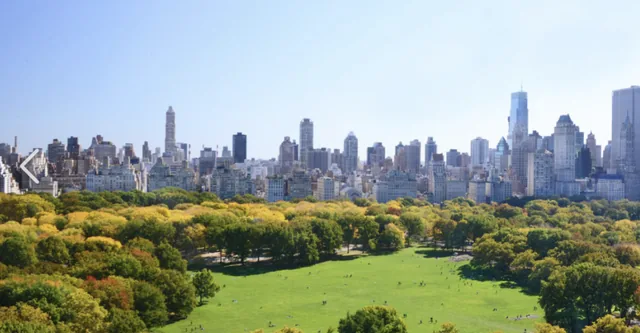 Beneath bright, cloud‑dappled blue skies, I step onto soft grass in Central Park, New York’s treasured urban sanctuary. All around me, trees glow with early autumn hues: rich greens blend with bursts of gold and faint fiery red. Tiny human figures dot the wide open meadow, some sprawled out for picnics, others strolling or tossing frisbees. Beyond the treeline, Manhattan’s famous skyline rises sharply, rows of gleaming skyscrapers framing this great stretch of green space.
Central Park holds fascinating history. Designed in the mid‑1800s by Frederick Law Olmsted and Calvert Vaux, it was America’s first major landscaped public park. Back then, fast‑growing New York City was crowded and industrial, and city leaders dreamed of building a peaceful escape where people of every social class could find rest from noisy city streets. Thousands of workers reshaped this land, moving tons of soil, planting tens of thousands of trees, and carving out meadows, lakes and winding paths across what was once a rough, undeveloped terrain.
I follow a shaded walking trail, the rustle of autumn leaves under my shoes. The distant hum of city traffic softens behind thick tree cover. Looking toward the towering high‑rises, I marvel at this striking contrast: wild, calm nature sitting right in the heart of one of the world’s busiest cities. More than 160 years later, Olmsted’s original vision still lives on. Here, office workers, families, tourists, and locals all come together. I pause to breathe fresh air, forgetting for a moment the rush of Manhattan just beyond the trees. Central Park is far more than grass and trees — it is a living, historical gift for everyone.